Automotive
Formable organo-sheets for series production. The parts return to the process at end of life.
Meets the EU 85 % recycling requirement
Two industries alredy exist. Renobrac creates the link between them.
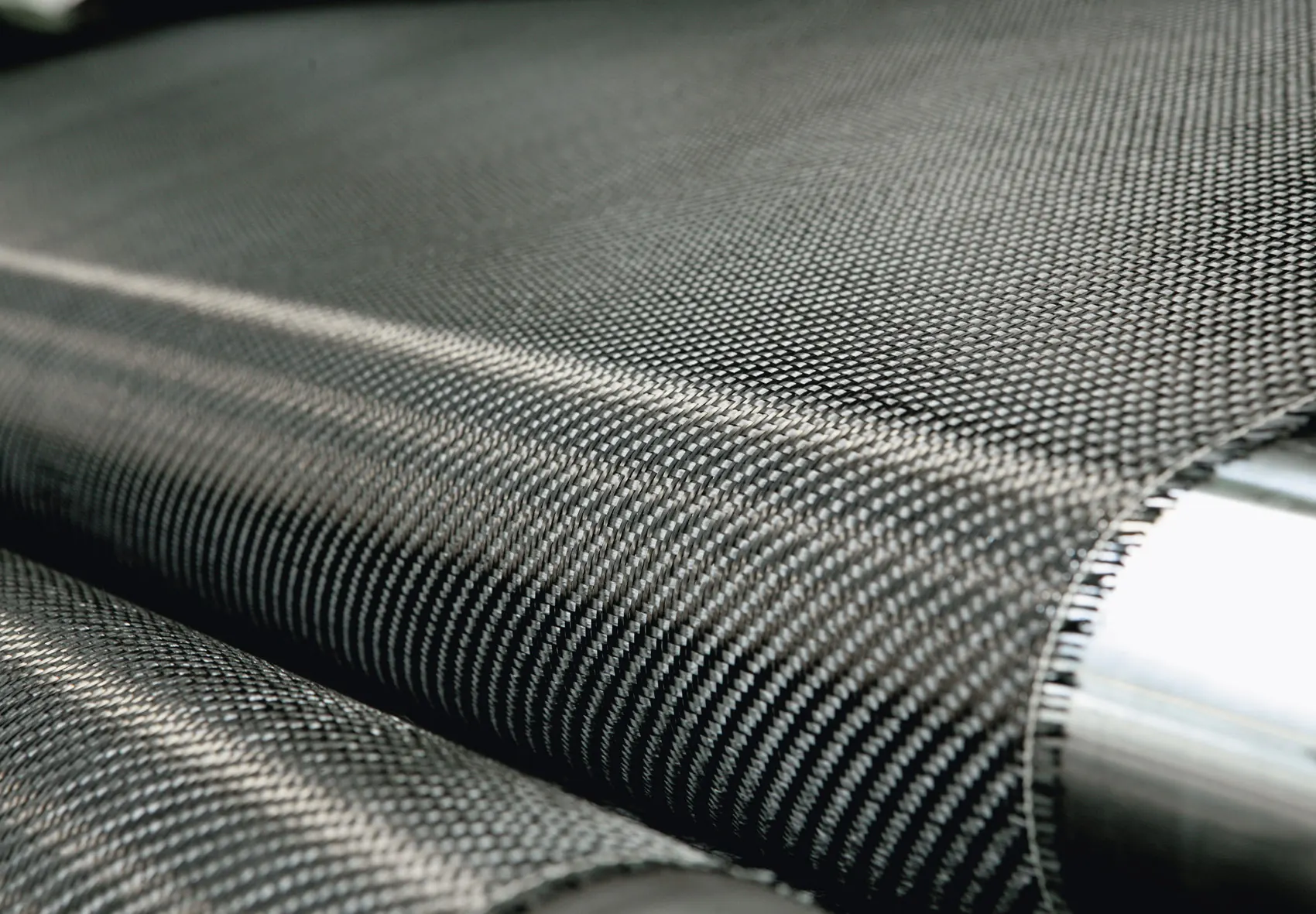
Complicated processing and the restriction to downcycling have limited the market potential of carbon fiber. Renobrac changes the processing and product economics.
only of all carbon fiber waste becomes a new structural component. The rest counts as hazardous waste, ground into filler,
or used in downgraded products.
offcut rate in prepreg production alone. That material never became a part.
Carbon fiber products are $5.75 bn today, over 100,000 tonnes a year. Cost and cycle time set the ceiling, not demand.
The recyclate market is cheap. Just $234 m. Much of the material is a disposal cost to its owner. Input is available by the tonne, at or below zero.
The EU requires 85 % recycling for vehicles. Every OEM using carbon in automotive or aviation needs an answer.
80 % of virgin strength. More flexibility to design and manufacture. Compatible with production equipment the industry already owns.
Matrix and reinforcement integrated. PA6 as standard. PEEK optional, titanium blended in on request.
Corrosion-free carbon fiber reinforcement for ultra-high-performance concrete. No cover layer needed.
Consolidated, formable sheet stock. Heat it, press it, and the part is done.
Continuous fiber at 90 % lower cost than performance carbon filament. On industrial 3D-printers.
Carbon already appears in each of these industries. But price and cycle time keep it off the main line. The Renobrac carbon revolution eliminates the barrier.
Formable organo-sheets for series production. The parts return to the process at end of life.
Panels and seat shells on a closed loop. Production offcuts return as parts.
Corrosion-free reinforcement for ultra-high-performance concrete. No cover layer needed.
Orthoses and prosthetic sockets knitted to a scan. Radiolucent parts for imaging and radiotherapy.
Exoskeleton frames and conformal armour formed to fit the individual wearer.
Structures and cabin parts at series volumes. Carbon performance at fiberglass pricing
The potential is unlimited: robotic arm links formed in one piece · small-series motorsport bodywork · space booms that pack soft and cure rigid · pressure-vessel overwrap · sports equipment with stiffness varied through the knit pattern · UHPC: pre-fabricated tiny houses and emergency shelters · low impact wind turbine foundations
Two mature industries sit on either side of Renobrac. Existing manufacturing ecosystems. Only the step between them was missing.
End-of-life parts and production offcuts. Already collected and processed into recovered fiber.
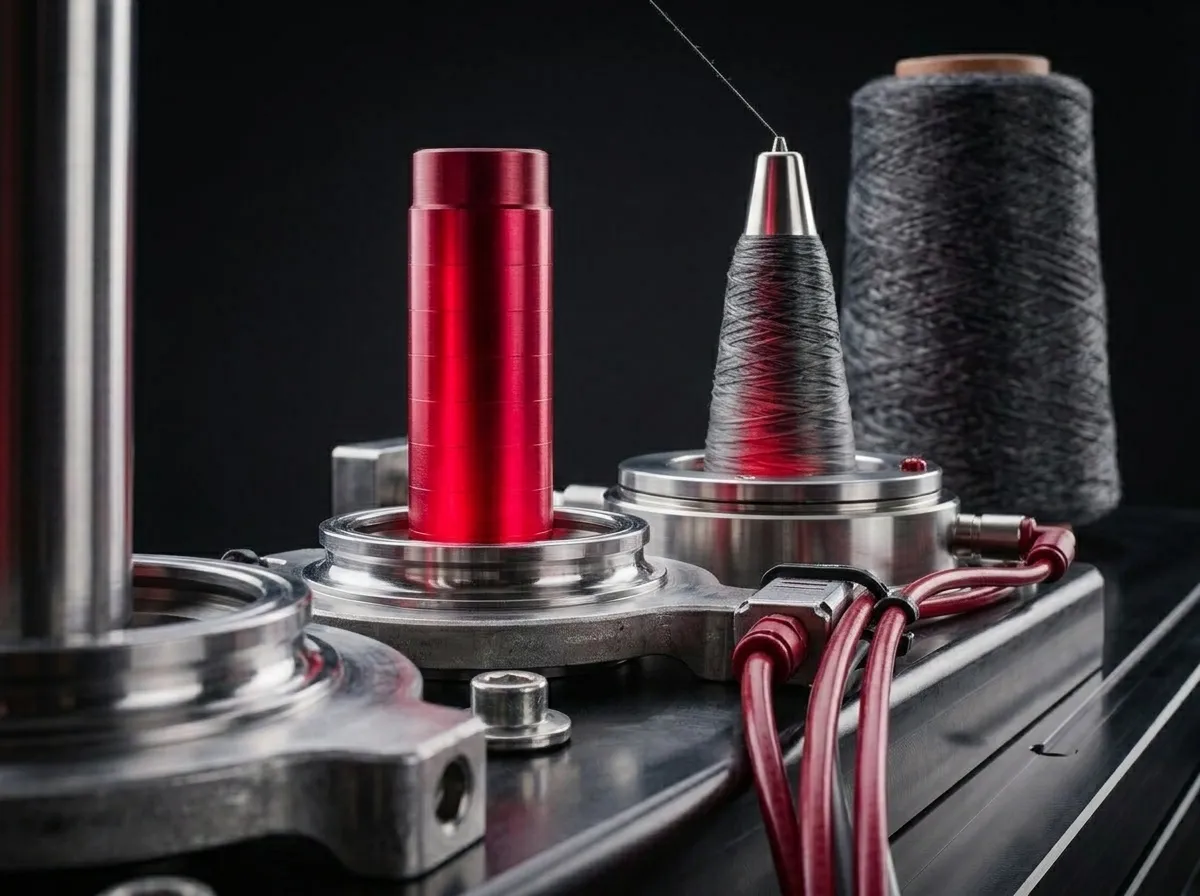
Air-bearing spinning turns recovered fiber into a hybrid yarn with the matrix already inside.
The only new element in the chainWeaving, knitting, braiding, thermoforming, over-molding. Installed global capacity.
Our upstream is available today: low-cost recyclate. Our hybrid yarn unlocks installed capacities downstream.
Cut and lay up the plies. Force resin in under pressure, or work with pre-impregnated material that needs a shelf life and a freezer. Then cure. Hours in an autoclave, one tool occupied throughout.
Hours per partThe matrix already sits between the filaments. Nothing needs impregnating. Heat the sheet, press it into shape, let it cool. Deep-drawing sheet metal works the same way, at the same kind of cycle.
Minutes per partConventional carbon needs a slow impregnation step under pressure. The alternative arrives
as semi-finished material that sets once and never reshapes. Renobrac spins the matrix into the yarn, so the
sheet stays formable. That single difference drives down the cycle time.
Renobrac spins recycled carbon staple fiber together with thermoplastic staple fiber into one hybrid yarn. The process rests on 100+ patents in contactless air-bearing motion. This foundation enables the Renobrac platform.
Both follow from the spinning itself. The mix is a parameter:
PA6 as standard, PEEK and titanium reinforcement already tested.
Carbon fiber is abrasive. Spinning units with conventional bearings fail within minutes. Every commercial spinning attempt has stopped there.
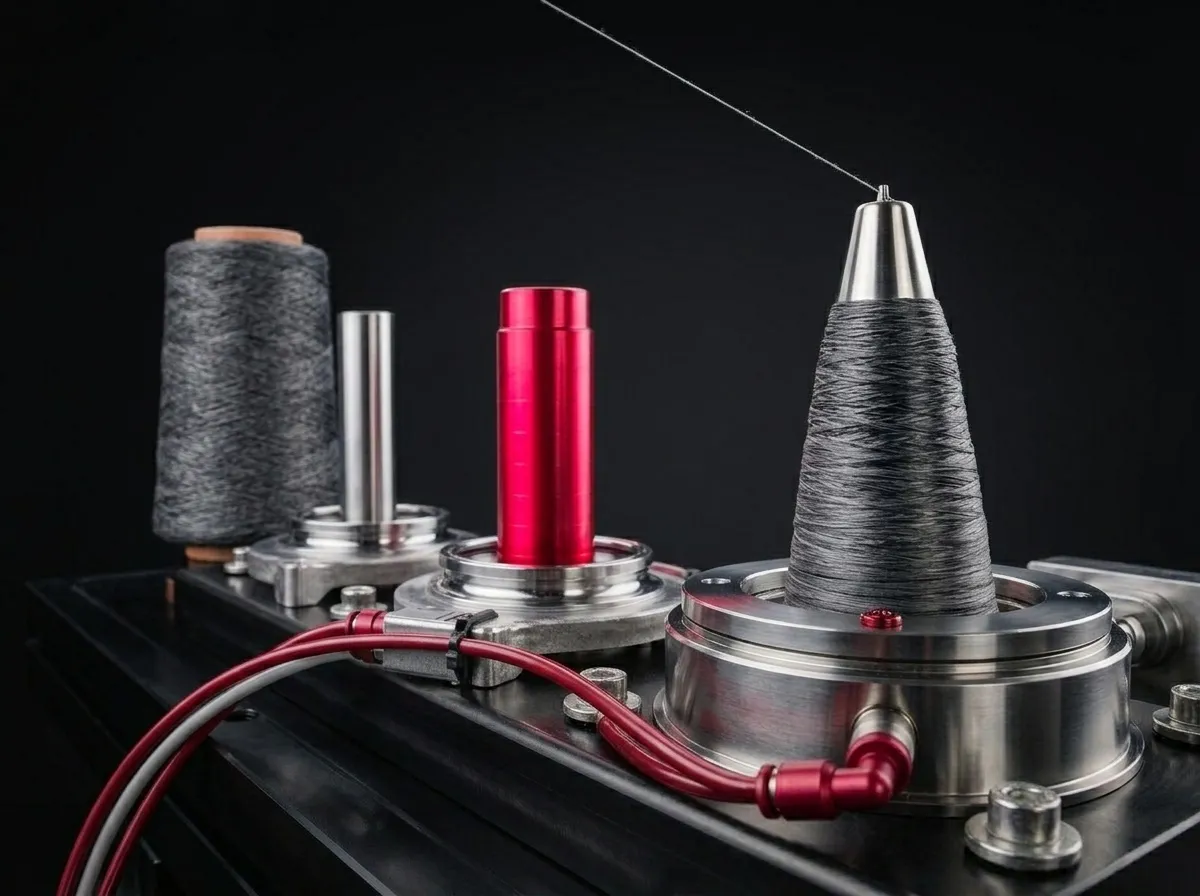
Renobrac has eliminated wear by eliminating touch and friction.
Carbon recycling itself is old news. Fiber recovery was never the hard part. Several processes recover the fiber, and they
do it well. None of them produced a material the downstream industry could run. The fiber came back short and
loose, and stopped there. Processing recovered fiber failed at the spindle.
Renobrac solved that one element. The moat is therefore not the machine but the position: Renobrac is the only route from recovered carbon into the textile industry that already exists.
The technical risk is behind us. The scaling decision is ahead.
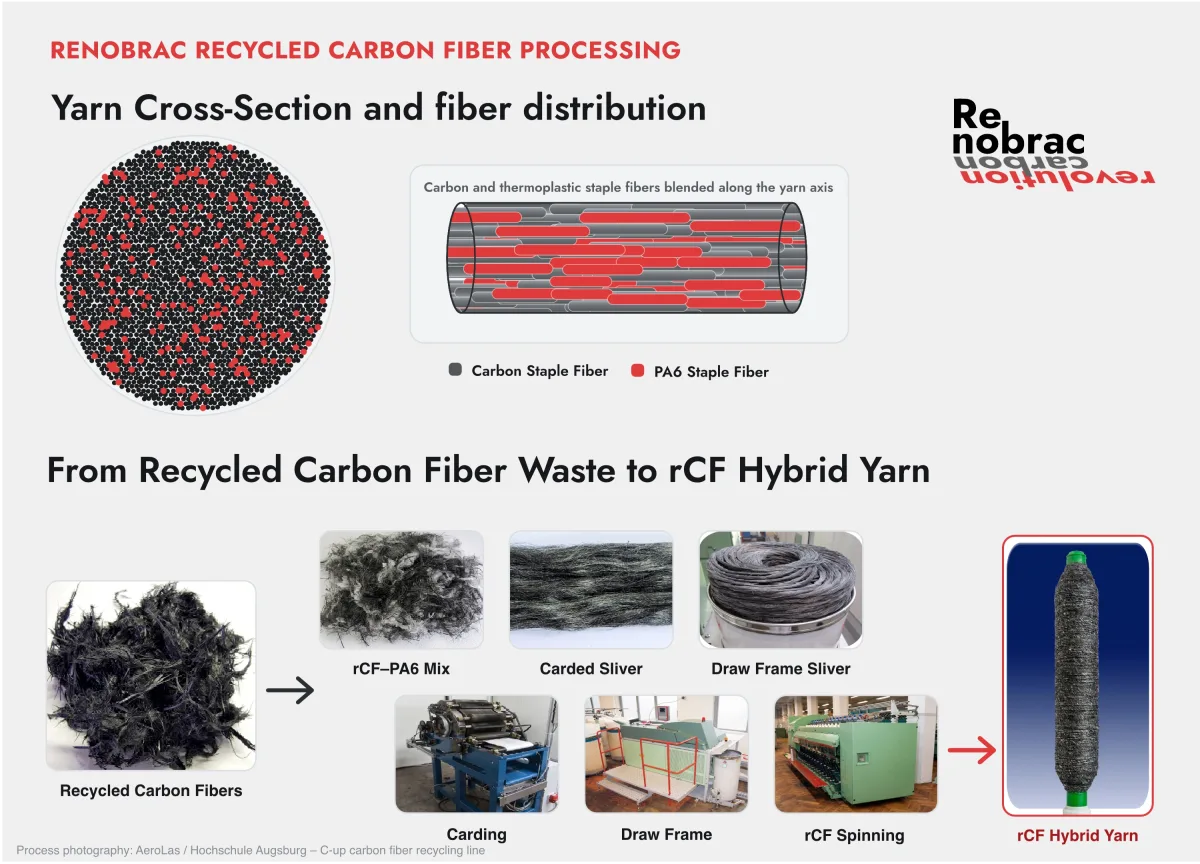
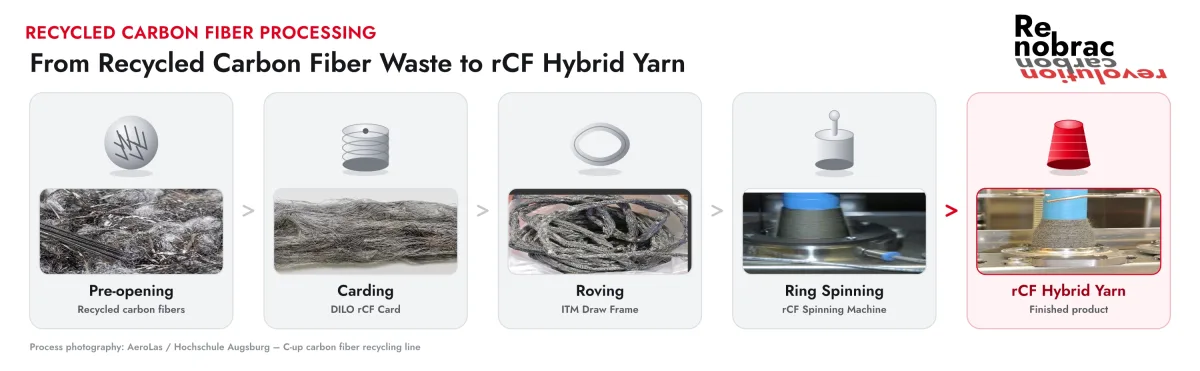
Recovered feedstock runs through carding, drawing and roving into spun hybrid yarn. Validated on end-of-life parts and on production offcuts.
About 80 % of virgin tensile strength. Higher elasticity, faster processing, and measurably better behavior in 3D-printing.
Carbon rods for ultra-high-performance concrete, organo-sheets, and continuous-fiber 3D-printing.
Validated with industrial and scientific partners .
Wind, aerospace and automotive are entering their first large end-of-life waves. Renobrac also takes production offcuts: a cleaner input, an upcycling route, and the better margin.
Renobrac is the only party spinning this material at scale today. That advantage has a shelf life.
The yarn is a materials industry platform. Renobrac supplies the platform, a partner opens the markets. The value sits in that split. It unlocks design and cost barriers.
The base product — spun, on cones. Matrix integrated
Textiles, tapes and braids in any fiber direction.
Consolidated, formable sheet stock.
Continuous fiber at €10–15/kg, against roughly €800 for conventional filament.
Corrosion-free bars and meshes for concrete.
Composite waste is already sorted, traded and processed. The grades no one else can use are the cheapest ones on the market.
| Dry, sorted carbon fiber | Can carry real material value. At volume and cleanly separated: take-back, credit or low-cost supply are all possible. |
|---|---|
| Uncured prepreg offcuts | A disposal cost for the producer. The most attractive grade for a recycler. Renobrac’s core feedstock. |
| Cured offcuts & milling dust | A disposal cost. Reprocessing is demanding, so the material ends up in asphalt. |
| Contaminated or mixed | The most expensive grade. Sorting and treatment come on top. |
Intermediates are commercially available by the tonne today. Renobrac buys where others pay to dispose, and starts without any upstream build-out.
We share capital requirements and milestones in the briefing, tailored to your route.
The technology is proven. The position is defensible. The next phase is about creating industrial scale.
A manufacturer, converter, CF recycler, or materials group that already owns a route to market and
wants a structural advantage on it.
A fund taking a materials position early. The technical risk is retired. The remaining work is commercial.
Fiber recovery has worked for years. What no process delivered was a recovered material the downstream industry could run. The fiber came back as short, loose staple with nowhere to go. Commercial attempts to spin it failed at the spindle: carbon destroys a conventional bearing within minutes. Renobrac solved that single step.
Recycled fiber is shorter. The yarn reaches about 80 % of virgin tensile strength. In most applications tensile strength is not the binding constraint. Drapability, cycle time and cost are, and the hybrid yarn leads on all three. Where the last 20 % genuinely decides the part, virgin fiber remains the right choice.
Nearly all of it. Opening, carding, drawing and roving are standard textile processes on standard machines. Everything downstream of the yarn runs on installed industry capacity: weaving, knitting, thermoforming, over-molding. One element is new, the air-bearing spinning unit.
The complete process chain has been validated with DITF Denkendorf, SGL Carbon, TU Graz and Hochschule Augsburg, using both end-of-life parts and production offcuts. Industrial scale-up is the next step.
PA6 is the standard. PEEK spins successfully. Titanium blends in on request. The mix is a process parameter, not a fixed property.
A first briefing without obligation. Then an NDA. Then a technical deep dive on your parts and volumes. Scaling routes come last: industrial partnership, investment, or a combination.
A partner to scale: industrial, strategic or financial. The technology is proven. What it needs is capacity and market access.
A focused conversation on where the Renobrac materials platform expands your markets, products or your portfolio. What the yarn does. How to process it. What it costs to run. What scaling takes. Under confidentiality.
What the hybrid yarn unlocks. Where it beats virgin fiber, and where virgin fiber still wins.
Whether your parts, volumes and cycle times fit. Which product family comes closest.
What industrial scale-up requires. Which partnership and investment routes are open.
Our air-bearing spinning unit is the only one that survives carbon in a production environment.
AeroLas has engineered ultra-precise, contactless air-bearing motion systems for over 25 years.
The company holds a market-leading position across demanding industrial and aerospace applications.
Renobrac carries that capability into new materials. The same air-bearing fundamentals that move wafer stages without contact also carry a spindle that abrasive carbon cannot destroy.
Renobrac sits at the point where a waste stream turns into a new performance material platform, with the engineering heritage to back it.

Michael leads AeroLas and its spin-outs, driving the transition from niche air-bearing solutions into high-growth markets — from semiconductor motion systems to carbon materials.
He has steered the company since its foundation in 1997 and is the public face of its mission to drive performance leadership through product innovation.

With over 20 years of experience across industrial, telecommunications, high-tech, and aerospace sectors, Hans-Friedrich bridges business strategy and technological execution.
Educated in computer science (James Madison University) and business (EBS, St. Gallen), he brings strong expertise in digital transformation, corporate finance, and operational excellence.
Thomas is an engineer at heart and a market-builder by trade. His passion is to bring innovations to market and empower technology companies to increase revenue, profitability, and value.
He tackles the common growth challenges in tech commercialization and works hard to turn technology into traction.